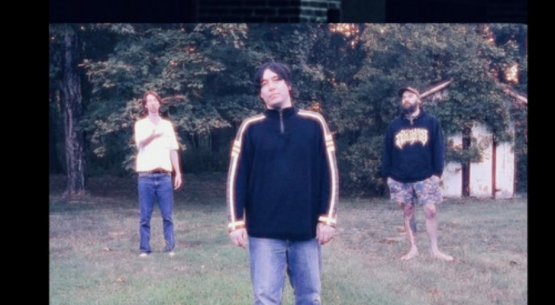
I am too young to have been around when Bob Dylan was writing world-changing music. I didn’t get to hear Sam Cooke sing about a change that was going to come. But I am fortunately just the right age to be here for Jesse Welles. I featured a few of his albums last year when his prolific 2025 saw him skyrocket to mainstream fame. This year, his album Masks Off has taken another step not only towards being a fantastic folk album, but having this transcendent rock, alternative, and political ethos about it that is certain to show up on end-of-year lists in the coming months.
Pretty much every song on this album I would be able to say that it has a loaded political message, but the opening track, “Masks Off,” is quite direct in addressing the political situation in the United States. There are so many clever turns of phrase, I would never be able to address all of them in a review, but it’s the kind of song that even if you listen to it a dozen times, on the thirteenth you will hear something new, some clever phrase that points to the injustice in society. I don’t quite understand how Jesse Welles is able to write at this savant level, but he continues to do it over and over. Every interview that I’ve seen with him, when people ask about the process, he just claims he’s telling the truth, and he’s sharing his feelings about the situation. He’s modest in his ability to almost prophetically speak truth. This song is evidence of exactly that. He says, “All the masks are off and they don’t even try. They know that you know they know and they don’t even mind it.” It’s a song about how corruption is now not even hidden. It’s in plain sight. The masks are off and we’re left with very little recourse.
While the opening track is a hard-hitting alt-rock political ballad, when we move to the second song, “Everything Must Die,” while the title sounds negative, the message is anything but negative. It’s uplifting. It’s bright. The chord structure makes you feel good. It has a sense of maybe a ’70s folk rock song mixed with ’90s alt rock in the way of the music that you could put on the radio while you were out for a drive or spending a day at the beach. The lyrical sentiment of the song: “How does it feel to be free? Is it all that you wanted, all that you dreamed?” It’s really this question about dying to self. Everything must die, including your own ego. That’s the inherent message of the track. And Welles has this, again, prophetic ability to express the need that humans have to unshackle themselves from the stresses of the world. The song has this poetic energy from start to finish. It sounds nice and comforting, but is really talking about an intensely important human action. And it comes across as a wonderful, engaging, captivating song.
So if you were around my writing last year, you’ll know that my song of the year for 2025 was Jesse Welles’ “Will the Computer Love the Sunset?” And his track “Technopagans” on this album picks up where that song left off, being critical not only of Silicon Valley itself, but also the ways that there seems to be a direct decision to undermine human life and prosperity through technology. His line, “The benevolence of predators will always blow my mind,” is such a clear reference to the tech oligarchs who are corrupting the world and pretending that it’s for everyone else’s benefit. Every line of the song is worth exploring, but it’s the sentiment that I wanted to highlight here. This is Welles commenting not just on the political world, but on the power brokering of corporate and tech worlds that has an outsized influence on modern society.
The next song I want to highlight is “Siddhartha,” which of course is a reference to Eastern religion, and if you grew up in a certain age bracket, you will know that a lot of instrumental artists from the 1960s made a similar turn towards Eastern philosophy as a way of making sense of the world, particularly in response to Western corruption. So this is not at all surprising to hear how Welles does this with these lyrics. Now, it’s a little more outrageous of a storyline than some of his other pointed and prophetic-sounding songs. This one has imagery of a man in a yellow cloak and a ferryman alongside some other characters guiding. But I believe that the most important part of the lyrical message comes at the end of each section. He says, “Do you want to know a secret? Do you want to know the truth? The river is laughing and we’re only passing through.” And this could be a reference to many different philosophical and existential ways of being, but it mostly seems to be a reference to the fact that our life is temporal and that we can’t hold on to things, and the sooner we realize that we are a soul going through this experience, then we can be free and not be shackled by the aspects of this life that prevent us from experiencing that freedom and lightness. It’s a wonderful song when it comes to the instrumentation. It’s got a bright and expressive acoustic guitar, and Welles sings with a different sort of energy on this track compared to others on the album. He seems optimistic despite the undertones of the song being ultimately a bit dark. I think it’s a brilliant performance and one of my favorites on the album, even if I still feel like after many, many listens that I don’t 100% catch the meaning. In some ways, I feel like that is getting it, to keep trying, to keep seeking, and to keep learning from the message of the track.
So a few of the songs at the end of the album come back to the political commentary, and one of those is simply called “Red.” It’s making some really interesting commentary on red as an association with the Republican Party, but then I believe that there’s some commentary on how red is also associated with communism back during the Red Scare of the 1940s and ’50s. So even with that level of analysis, each line deserves its own commentary. We could write a dissertation on the depth of all of the threads that Welles is pulling here. One of his main commentaries is about the level of corruption and the layers of interconnectedness between the folks who are entrenching themselves in power. Then he writes, “Who would have ever thought the deep state were the National Park Rangers?” which is a clever line referencing the National Park Service and some other political associations. But he’s got this central motif about taking red pills or blue pills in reference to The Matrix, but also in reference to the political parties. And he says, “When the war gets here, we’re gonna get on the level. Everyone will look a little bit nicer when you finally meet the Devil.” I do believe that that has both spiritual connotations as well as political connotations. There’s so much that we could say about the song, but I wanted to highlight the fact that it’s got this Tom Petty-style folk rock element, and I was also put in mind of Don McLean’s “Bye Bye Miss American Pie” song. Rather than telling a story of the past where the levee was dry, Welles is casting a vision towards the future when we’re on the level, when we get to this dangerous and awful place that we’re heading.
I could probably write about all of the songs on this album with the same level of depth. Each one has its own mystery and fascinating layer. But I mostly want to end the review by saying this is not merely music. This is a cultural artifact of our time. We don’t find artists like this often. Most of the time the music that we run across is temporal. It’s pointed. It’s referencing a breakup or a personal experience that an artist hopes that someone else will relate to. What Jesse Welles is doing in this album is speaking for many, many people, particularly Americans, who are having a truly unique political experience. I, for one, am looking forward to seeing how perhaps the tune and/or message will shift in 2027 and beyond. But for right now, it feels like a distinct privilege to sit at the feet of Jesse Welles, the songwriter, who also happens to be speaking in a truly unique and significant voice for our time.
Discover more from Ear To The Ground Music
Subscribe to get the latest posts sent to your email.