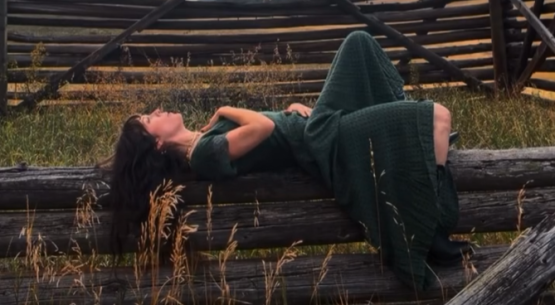
From the first time I heard Jesse Welles, I knew he was special. It’s his affect, his phrasing, his easy way with the guitar or the harmonica, and most certainly his generational lyricism… it all rolls together into something spectacular. He’s been everywhere now, on late night shows and featured by big stars. I’m sure you’ve heard him. You don’t need a spotlight from me to know about Jesse Welles. Nevertheless, just like he doesn’t need to write another jangly country tune like Roger Miller or a scathing folk ballad like Bob Dylan, he writes anyways… and so I shall.
It would be easy for me to highlight only the political ballads like “War Isn’t Murder,” but that’s not the sum total of Welles’ work. If you’ll allow me to be direct, the main point of this spotlight is that I don’t want you to think of Welles as only one thing. He is one of the most versatile artists we’ve heard in years, more in the vein of Billy Strings than traditional folk artists. While Welles does write about political corruption, that’s not his whole personality or identity.
One of my favorite moments since following the rise of Jesse Welles when one of the big news agencies interviewed him (CBS) and the interviewer asked if he thought of himself as a political figure. Jesse Welles laughed. He laughed in that quiet, “are you serious?” kind of way. It was charming and genuine. In a world with fakeness and artificiality all around, it’s really nice to just see and hear a good person from Arkansas sing about the truth.
I could spend time breaking down the messages of songs like “Join ICE” or “Great Caucasian God” because they are, in so many ways, works of literature on their own. But the great thing about Welles’ writing is that he’s pretty direct. Just play the songs and you’ll understand the message. Despite his clever layering of meaning on some tracks, he can also write with a sort of “everyman” accessibility that really reminds me of Woody Guthrie and Pete Seeger. It’s clear that Welles has the intelligence to write esoteric and inaccessible messages, but he conveys the truth that he perceives with a language that is fluid and captivating. He wants you to understand.
In addition to his three studio albums released in 2025, Welles also released songs on YouTube in self-shot performances. These tracks, often “under the powerlines,” a series he released later on streaming platforms, drip with authenticity. Whether he’s singing about a loaded social equality message, riffing on corporate corruption, or just enjoying nature, his authenticity is the calling card.
One of his most vibrant viral moments came with “United Health,” a song about the murder of United Health’s CEO. The line “there’s hardly humans in humanity” comes through in the song as a deep truth. Welles tells the story of why health insurance is now more about corporate profits than it is about caring for people. It’s a tragic story, really, and nearly everyone in the United States can relate to the message. Welles gives voice to the many thousands who feel disenfranchised or outright bankrupted by this system.
Tracks like “Red” are the ones that get Welles onto the big time shows because it’s the least socially abrasive for the censors. However, if you listen closely, even “Red” is about political corruption. The chorus, “when the war gets here, we’re gonna hold hands…” It’s a bit sardonic, a bit unsettling, but it feels almost prophetic in its incisive commentary. Most folk artists would give anything for one track this good, but Welles seems to turn one out every week. His YouTube channel releases some of the most nonchalant, accessible, enjoyable tunes each week… and even the ones that seem like deep cuts are wonderfully cathartic.
But beyond all of these specific messages in specific songs, I wanted to highlight Jesse Welles because of what he stands for in the American music story. We haven’t had a troubadour of his ilk in a generation or more. He’s defining (and pushing to redefine) what it means to be an American based on good questions, a sincere heart, and a sort of common sense democracy that goes beyond party loyalty. He doesn’t talk about who to vote for or campaign with his platform. He just sings these songs, bouncing between deep philosophy, existential reality, and a delightful ode to “Bugs.” And, come to think of it, even that is an existential song. “I like bugs and I’ll tell ya why, they’re alive and so am I.”
If this is your first time hearing of Jesse Welles I’d honestly be shocked, but if you’re here because you’ve been impressed by him, I invite you to join the club. When I wrote my review of his album Pilgrim I kept writing how the next song was the best song on the album; they’re all outstanding. He has that uncanny ability, like John Prine, to tell stories that make you feel something for strangers. I wouldn’t be much of a music writer if I didn’t give you some “for fans of” here, so let’s just go with Bob Dylan, John Prine, and Roger Miller. That’s some pretty iconic company and I genuinely do not feel like it’s overstating in the slightest.
If you only have time for one, I might recommend, “Will the Computer Love the Sunset?” If you have time for two, my other recommendation is definitely, “Good Morning America.” It puts me in mind of Steve Goodman’s classic “City of New Orleans.” Please find yourself three and a half minutes to listen to this song; you’ll understand why he’s capture a generation of folk fans so well.
Jesse Welles is a modern classic. Enjoy his work.
Discover more from Ear To The Ground Music
Subscribe to get the latest posts sent to your email.